Yashwant Varma Cash Case: Panel Finds Charges Proved, Flags Failure to Explain Cash
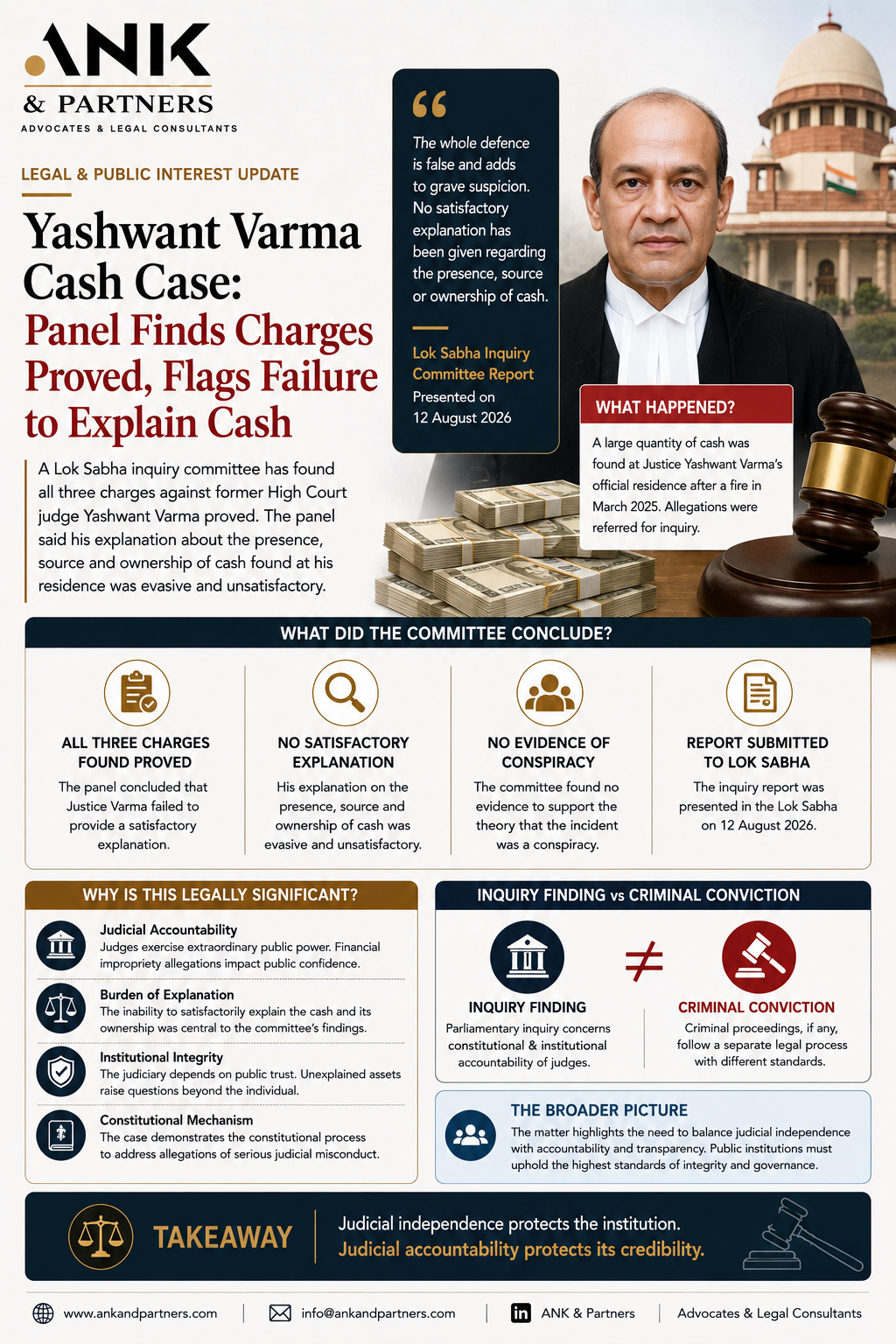
Yashwant Varma Cash Case: What the Parliamentary Panel Found
The controversy surrounding former High Court judge Justice Yashwant Varma has entered another significant phase after a three-member Lok Sabha inquiry committee found the charges against him proved.
The committee examined allegations arising from the discovery of a large quantity of cash at the premises of Justice Varma following a fire in March 2025. According to reports on the committee's findings, the panel concluded that Justice Varma failed to provide a satisfactory explanation concerning the presence, source and ownership of the cash.
The committee's report was presented to the Lok Sabha on 12 August 2026.
What Did the Committee Conclude?
The inquiry committee reportedly found all three charges against Justice Varma proved.
Among the significant findings was the committee's rejection of his explanation regarding the cash. The report characterised his defence as evasive and unsatisfactory and found that the evidence did not support his explanation of how the cash came to be present at the premises.
The committee also reportedly found no evidence supporting the theory that the incident was part of a conspiracy to frame him.
Why Is This Legally Significant?
The matter goes beyond the question of unexplained cash.
It raises fundamental issues concerning judicial conduct, institutional integrity and accountability within the higher judiciary.
1. Judicial accountability
Judges exercise extraordinary public power. Allegations concerning financial impropriety therefore carry implications not only for the individual concerned but also for public confidence in the judicial institution.
2. Burden of explanation
The committee's findings place significant emphasis on the inability to provide a satisfactory account of the cash and its ownership. The evidentiary assessment formed a central part of the committee's conclusions.
3. Institutional integrity
The judiciary depends heavily on public confidence. Questions concerning unexplained assets or financial conduct can therefore have consequences extending well beyond an individual proceeding.
4. Constitutional accountability
The proceedings also demonstrate the constitutional mechanisms available for addressing allegations of serious misconduct involving judges of the higher judiciary.
Important Distinction: Inquiry Finding vs Criminal Conviction
The committee's finding that the charges are proved should not automatically be described as a criminal conviction.
The parliamentary inquiry concerns the constitutional and institutional process relating to alleged judicial misconduct. Separate criminal proceedings, if any, involve their own legal requirements, evidence and adjudicatory process.
That distinction is important when reporting developments involving judicial officers.
The Broader Legal & Institutional Implications
The case highlights several questions relevant to the administration of justice:
- How should allegations of judicial misconduct be investigated?
- What level of transparency should accompany such proceedings?
- How can judicial independence be protected while ensuring accountability?
- What mechanisms should apply when allegations concern financial impropriety?
- How should institutions preserve public confidence during high-profile inquiries?
The challenge is to maintain both judicial independence and meaningful accountability.
Neither should exist at the expense of the other.
Why Businesses Should Pay Attention
Although the matter concerns the judiciary, it carries a broader governance lesson for organisations.
Boards, senior executives, professional advisers and regulated entities increasingly operate under expectations of:
Transparency + Documentation + Accountability + Independent Oversight
Financial transactions, asset ownership and explanations for significant irregularities should therefore be supported by clear documentary evidence and auditable records.
For organisations, the principle is simple:
Good governance is strongest when accountability is built into the system before a controversy arises.
The Bigger Picture
The Yashwant Varma matter has developed over an extended period.
The Supreme Court had previously constituted an in-house inquiry into the allegations, while the later parliamentary process examined the matter under the constitutional framework applicable to removal proceedings. Justice Varma subsequently resigned in April 2026, but the parliamentary inquiry and its findings have continued to carry institutional significance.
The latest findings therefore represent another important chapter in a case that has placed judicial ethics, transparency and accountability under intense scrutiny.
Takeaway
Judicial independence protects the institution. Judicial accountability protects its credibility.
The enduring lesson from the case is that public institutions exercising exceptional power must also be capable of demonstrating exceptional standards of integrity, transparency and accountability.