Assessing Officer Cannot Act as an Economist to Rework Share Valuation: Delhi High
Assessing Officer Cannot Become an Economist to Rework Share Valuation
Can a tax officer reject a professionally prepared share valuation simply because he believes the company's expected return should be different?
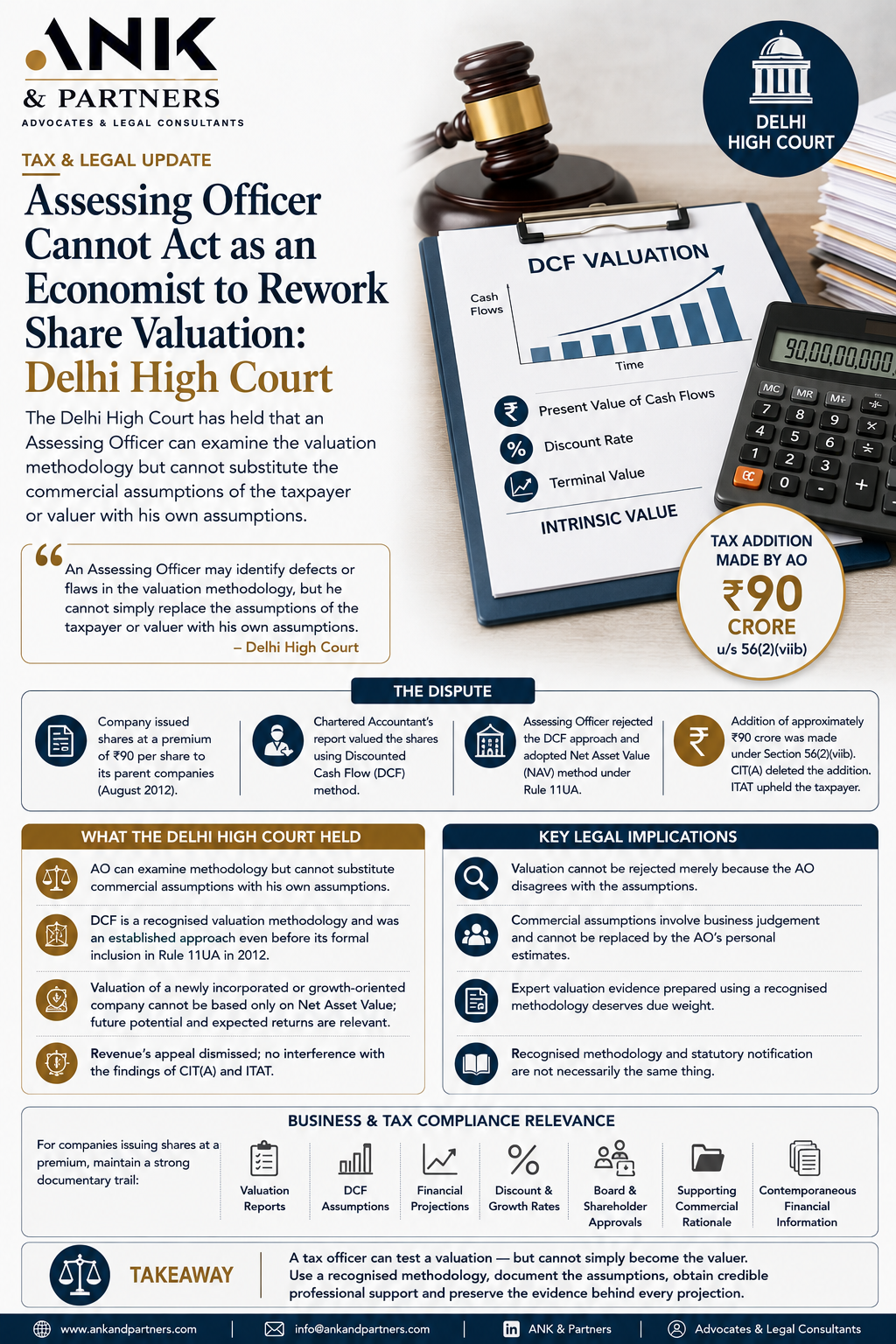
The Delhi High Court has answered with an important qualification: an Assessing Officer can examine a valuation, but cannot simply substitute the commercial assumptions of the taxpayer or independent valuer with his own assumptions.
In Pr. Commissioner of Income Tax–1 v. M/s Etawah Chakeri (Kanpur) Highway Private Limited, the Court dismissed the Income Tax Department's appeal concerning the valuation of shares issued at a premium.
What Was the Dispute?
The company had issued shares to its parent companies at a premium of ₹90 per share in August 2012.
A Chartered Accountant's report valued the shares using the Discounted Cash Flow (DCF) method.
The Assessing Officer rejected the approach and considered that the company should have used the Net Asset Value (NAV) method under Rule 11UA. This resulted in a tax addition of approximately ₹90 crore under Section 56(2)(viib).
The CIT(A) deleted the addition, and the ITAT subsequently upheld the taxpayer's position.
The Revenue then approached the Delhi High Court.
What Did the Delhi High Court Hold?
The Court rejected the Revenue's challenge.
It held that while the Assessing Officer can identify defects or flaws in the valuation methodology, the officer cannot simply substitute the commercial assumptions used by the taxpayer or valuer with his own assumptions.
The Court also recognised an important distinction between a valuation method being recognised in the financial and corporate world and its subsequent formal notification under the tax rules.
The Court noted that DCF was already an established valuation methodology, even though it was formally incorporated into Rule 11UA later in 2012.
Why DCF Matters
DCF valuation looks beyond a company's current balance sheet.
For a newly incorporated or growth-oriented business, factors such as:
- Future business potential
- Expected cash flows
- Market prospects
- Growth assumptions
- Expected returns
may be relevant to determining value.
The Court therefore observed that valuation based purely on NAV may not necessarily capture the true worth of a newly incorporated company.
Key Legal Implications
1. Valuation cannot be rejected merely because the AO disagrees with the assumptions
The tax authority must identify a substantive defect in the methodology or valuation report.
2. Commercial assumptions have to be assessed in context
Expected returns and projections involve commercial judgment. An Assessing Officer cannot automatically replace those judgments with a preferred set of assumptions.
3. Expert valuation evidence matters
Where a recognised methodology is supported by a professional valuation report, the underlying assumptions and methodology should be capable of being demonstrated and defended.
4. Recognised methodology and statutory notification are not necessarily the same thing
The Court distinguished between an existing, accepted valuation methodology and its subsequent formal recognition in the tax rules.
Business & Tax Compliance Relevance
The ruling is particularly relevant for:
- Startups
- Private companies
- Group companies
- Infrastructure businesses
- Companies issuing shares at a premium
- Promoters and investors
- Corporate finance teams
- Tax and valuation advisers
Businesses undertaking share issuances should maintain a strong documentary trail around valuation, including:
- Valuation reports
- DCF assumptions
- Financial projections
- Comparable-company analysis
- Discount rates
- Expected growth rates
- Board and shareholder approvals
- Supporting commercial rationale
- Contemporaneous financial information
The objective should be to ensure that the valuation is not merely prepared, but is also defensible.
A Broader Lesson for Tax Assessments
The judgment reinforces an important boundary in tax administration.
Scrutiny is legitimate. Arbitrary substitution is not.
An Assessing Officer can question methodology, identify inconsistencies and seek supporting evidence. But where a recognised valuation methodology has been properly applied, replacing the valuer's commercial assumptions without identifying a genuine methodological defect can be legally vulnerable.
Takeaway
A tax officer can test a valuation — but cannot simply become the valuer.
For companies and investors, the message is clear: use a recognised methodology, document the assumptions, obtain credible professional valuation support and preserve the evidence behind every material projection.