“Who Is This Segal?”: Supreme Court Questions Centre’s Objection to Chandrachud’s Adultery View
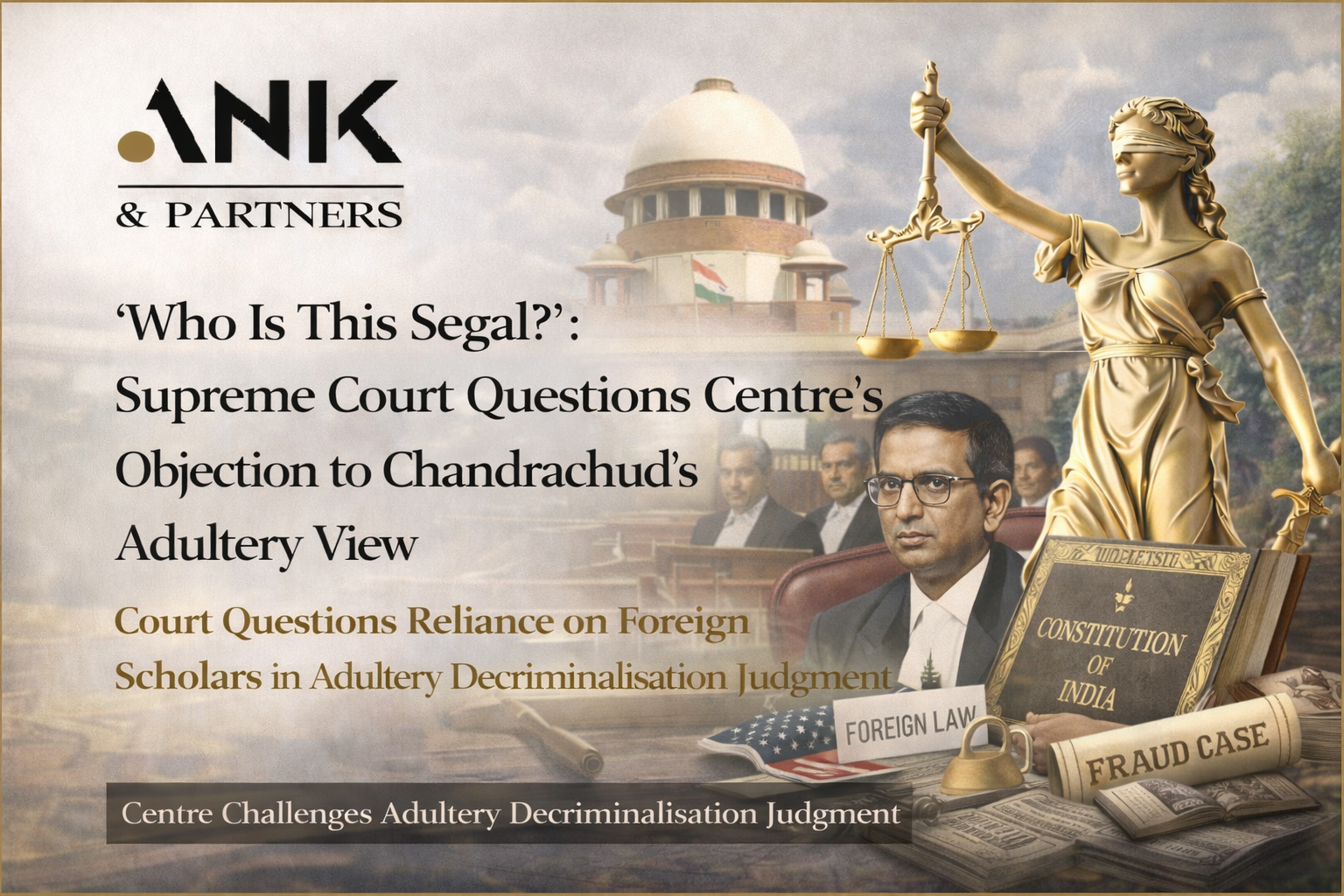
During an ongoing Constitution Bench hearing, the Supreme Court raised a pointed query—“Who is this Segal?”—while examining the Centre’s objections to the reasoning adopted in the landmark adultery decriminalisation judgment authored by former Chief Justice D.Y. Chandrachud.
The controversy arose when the Centre criticised the reliance on foreign scholars and international judgments cited in the 2018 ruling that struck down Section 497 of the Indian Penal Code. Solicitor General Tushar Mehta argued that “blanket reliance on international judgments is impermissible” and questioned the use of concepts like constitutional morality in such decisions.
In response, the Bench, led by the Chief Justice, expressed reservations about the weight given to such external references. The remark “Who is this Segal?” referred to American scholar Jeffrey A. Segal, whose work had been cited in the judgment. The Court noted that such academic opinions are ultimately subjective and may not carry binding authority in constitutional interpretation.
The issue surfaced in the broader context of the Sabarimala review proceedings, where the Centre has challenged the reasoning adopted in multiple landmark rulings, including those decriminalising adultery and homosexuality. However, the Court clarified that the validity of the adultery judgment itself is not under reconsideration in the present proceedings.
The 2018 judgment in Joseph Shine v. Union of India had struck down adultery as a criminal offence, holding it unconstitutional and violative of equality and personal liberty.
This development highlights an important constitutional debate—whether Indian courts should rely on global jurisprudence and philosophical concepts like constitutional morality, or strictly adhere to domestic legal frameworks. The outcome could have broader implications for how future constitutional cases are argued and interpreted in India.