Old Monk Maker Challenges FSSAI Ban, Citing ₹1 Crore Daily Loss
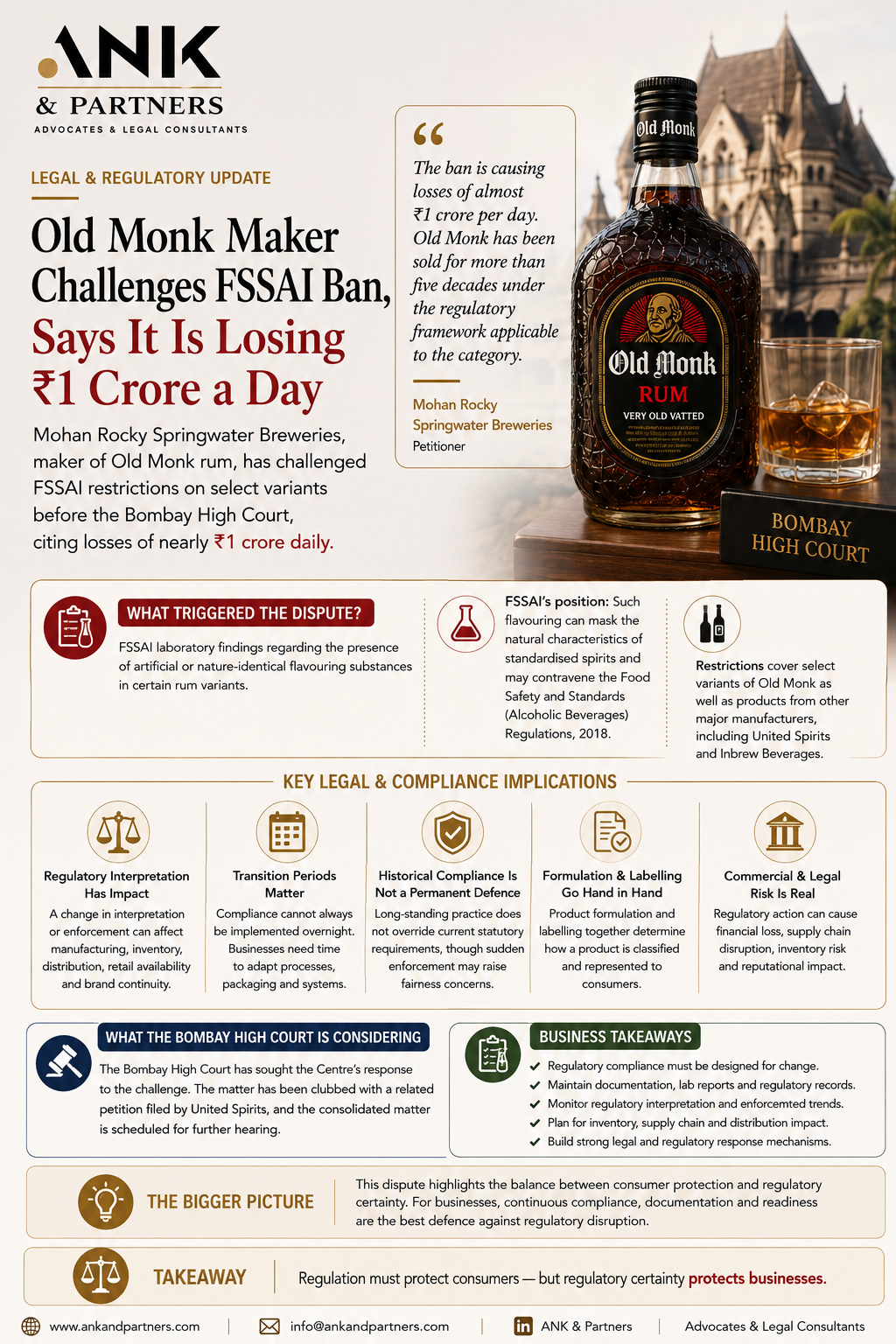
Old Monk vs FSSAI: When Regulatory Enforcement Meets Business Reality
A regulatory dispute involving one of India’s best-known rum brands has reached the Bombay High Court — and it raises questions that extend well beyond a single product.
Mohan Rocky Springwater Breweries, the maker of Old Monk, has challenged the Food Safety and Standards Authority of India’s (FSSAI) prohibition on certain rum variants.
The company told the Bombay High Court that the restriction is causing losses of nearly ₹1 crore per day. It also argued that Old Monk has been sold for more than five decades under the regulatory framework applicable to the category.
What Triggered the Dispute?
The regulatory action followed FSSAI laboratory findings concerning the presence of artificial or nature-identical flavouring substances in certain alcoholic beverages.
FSSAI’s position is that such flavouring can mask the natural characteristics of standardised spirits and may conflict with the Food Safety and Standards (Alcoholic Beverages) Regulations, 2018.
The restrictions reportedly cover select variants of Old Monk as well as products from other major liquor manufacturers, including United Spirits and Inbrew Beverages.
The manufacturers, however, have challenged the regulator’s interpretation and the manner in which the restrictions have affected long-standing products.
The Important Legal Distinction
One of the most important aspects of the dispute is that the companies have argued that the issue is not about consumer safety.
Instead, the controversy centres on:
- Whether particular flavouring substances are permissible;
- How standardised spirits should be classified;
- Whether existing formulations comply with applicable regulations;
- What disclosures or labelling are required; and
- How regulatory changes should be implemented for established products.
Key Legal & Compliance Implications
1. Regulatory interpretation can have immediate commercial consequences
A change in interpretation or enforcement can affect manufacturing, inventory, distribution, retail availability and brand continuity.
2. Transition periods matter
For established products, compliance cannot always be implemented overnight. Packaging, inventory, manufacturing processes and distribution networks may require significant time to adapt.
3. Historical compliance is not necessarily a permanent defence
Long-standing industry practice does not automatically override a regulator’s interpretation of current statutory requirements. At the same time, sudden enforcement can raise questions about procedural fairness, regulatory certainty and proportionality.
4. Labelling and formulation must be assessed together
Businesses in regulated sectors should not treat product formulation and product labelling as completely separate compliance issues. Both can determine how a product is legally classified and represented to consumers.
Business Relevance
The dispute offers an important lesson for regulated businesses:
Regulatory compliance must be designed for change, not merely for the rules that exist today.
Companies should consider maintaining:
- Periodic regulatory reviews of product formulations
- Documented compliance positions
- Laboratory and technical evidence
- Regulatory correspondence records
- Label and packaging approval processes
- Change-management protocols
- Inventory transition plans
- Regulatory litigation and enforcement response mechanisms
For businesses with established brands, regulatory risk should also be assessed alongside supply-chain disruption, inventory exposure, distributor relationships and reputational impact.
What the Bombay High Court Is Now Considering
The Bombay High Court has sought the Centre’s response to the challenge. The matter has been clubbed with a related petition filed by United Spirits, and the consolidated matter is scheduled for further hearing.
The court’s eventual consideration could have wider implications for how regulatory standards applicable to alcoholic beverages are interpreted and enforced.
The Bigger Picture
This dispute highlights a broader regulatory challenge:
How should regulators balance strict enforcement with predictability for businesses operating under established regulatory frameworks?
For companies, the lesson is equally important. Compliance should not be treated as a one-time certification exercise. It requires continuous monitoring of regulatory interpretation, technical standards and enforcement trends.
Takeaway
Regulation must protect consumers — but regulatory certainty protects businesses.
For regulated industries, the strongest compliance strategy is one that anticipates regulatory change, preserves evidence and allows businesses to respond before enforcement becomes a crisis.