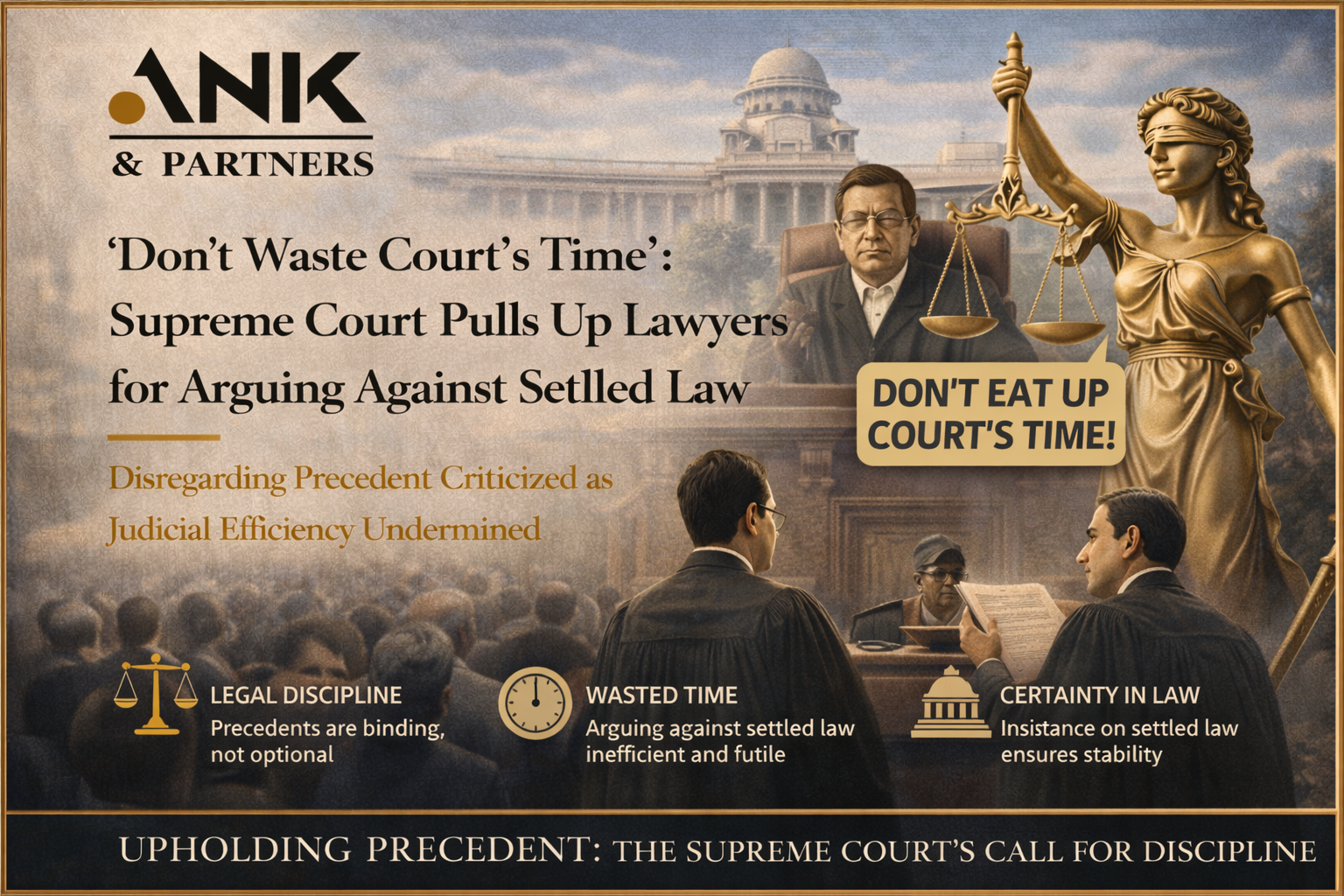
“Don’t Waste Court’s Time”: Supreme Court Pulls Up Lawyers for Arguing Against Settled Law
In a sharp and telling remark, the Supreme Court has drawn a clear boundary for courtroom advocacy—legal brilliance cannot come at the cost of judicial time.
The Court cautioned lawyers against advancing arguments that directly contradict well-settled legal precedents merely to demonstrate their argumentative prowess. Emphasising the doctrine of precedent, the Bench noted that once a Constitution Bench has laid down the law, it binds not only courts but also the manner in which lawyers frame their submissions.
The observation came in a case involving the computation of limitation under Section 468 of the CrPC. Despite a clear ruling by a Constitution Bench in Sarah Mathew v. Institute of Cardio Vascular Diseases—which established that limitation is to be counted from the date of filing the complaint—counsel attempted to introduce distinctions that the Court found artificial and legally unsustainable.
Rejecting such arguments, the Court made it clear that judicial time is a public resource, and advancing “worthless submissions” against binding precedent undermines both efficiency and discipline in the legal system.
The ruling goes beyond the facts of the case—it reinforces a foundational principle of Indian jurisprudence: certainty in law is as important as advocacy itself. While legal creativity is essential, it must operate within the framework of established precedent unless there are genuine grounds to distinguish or revisit the law.
At a broader level, the message is unmistakable. Courts are not forums for intellectual exhibition—they are institutions for effective, time-bound justice delivery.
For the legal fraternity, the takeaway is both practical and philosophical: respect precedent, argue with purpose, and remember that persuasion is strongest when it is grounded in settled law—not stretched against it.