Dabur Accuses FSSAI of Favouring Rivals in ‘100%’ Label Crackdown
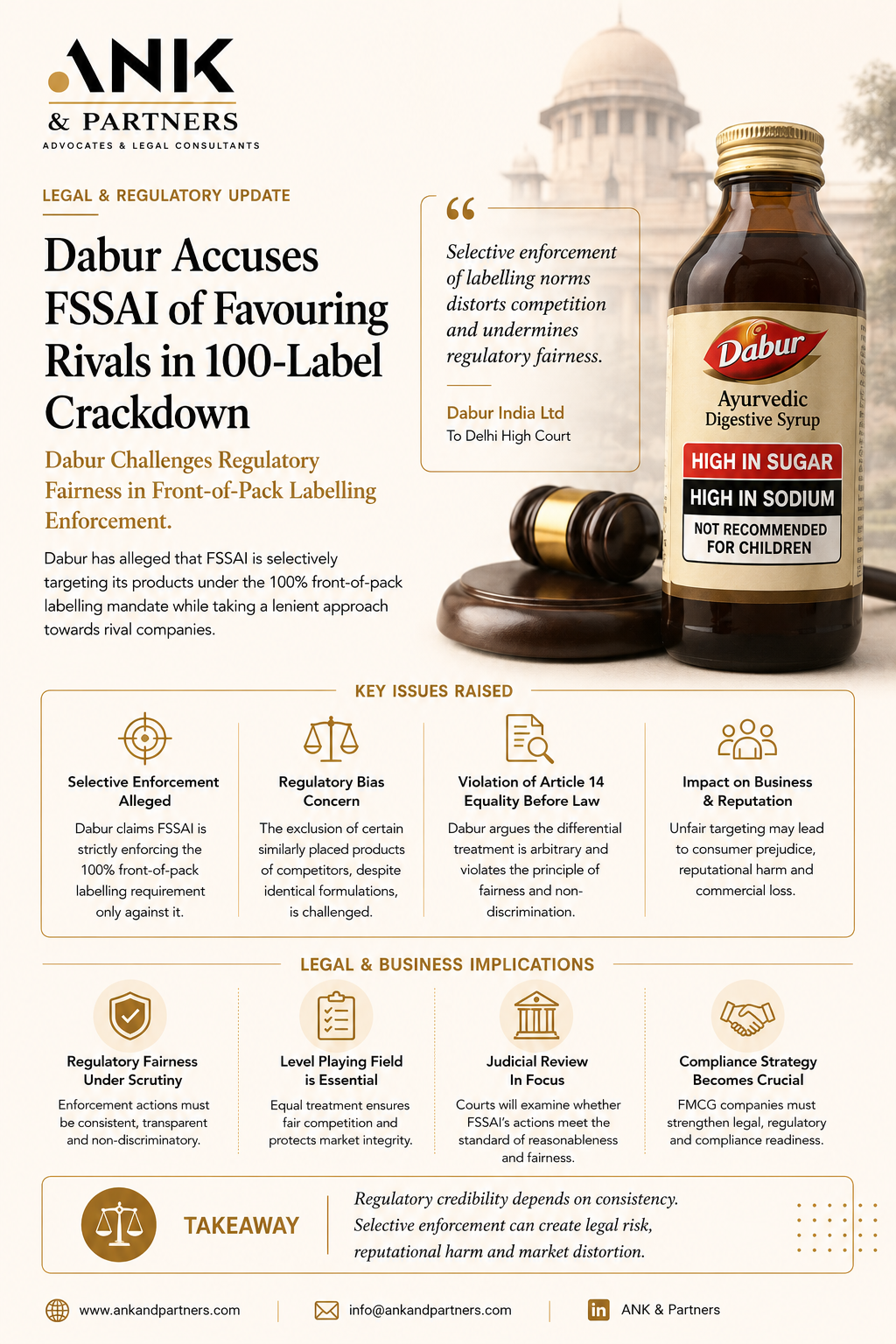
Dabur vs FSSAI: When Regulatory Enforcement Becomes a Question of Fairness
Can a regulator enforce a labelling standard against one company while similar products across the market continue to carry comparable claims?
That question is now before the Delhi High Court after Dabur challenged action by the Food Safety and Standards Authority of India (FSSAI) concerning the use of “100%” claims on food products.
According to Moneycontrol, Dabur has alleged that FSSAI’s enforcement action disproportionately targeted its products while similar “100%” claims were being used by other major brands. The company has also claimed that the action placed approximately ₹150 crore of inventory at risk.
FSSAI, meanwhile, has taken the position that such absolute claims can be misleading and contravene applicable food-labelling requirements.
What makes the case significant?
The dispute is not simply about a label.
It raises broader questions about regulatory consistency, procedural fairness, equal treatment and the commercial consequences of enforcement decisions.
Key Legal Implications
1. Regulatory consistency matters
Dabur has argued that similar “100%” claims are used across the industry. If enforcement differs between similarly situated businesses, questions of consistency and equal treatment can arise.
2. Procedural fairness is critical
Dabur has claimed that the prohibitory order was issued without first providing an opportunity to explain its position. The Delhi High Court subsequently stayed the FSSAI order until August 24, while observing that the company should have been heard before such a direction was issued.
3. Regulatory action can create substantial commercial exposure
The company says 11 products were affected and inventory worth around ₹150 crore was at risk. The dispute also reportedly affected retail availability, with channel partners temporarily disabling listings.
4. Article 14 concerns may become relevant
Where differential treatment of similarly placed businesses is alleged, the constitutional principle of equality before law can become an important part of the regulatory challenge.
Business & Compliance Relevance
For FMCG and other regulated businesses, the case offers an important compliance lesson:
Regulatory readiness cannot stop at technical compliance.
Companies should maintain:
- Evidence supporting product claims
- Label-by-label regulatory assessments
- Records of regulatory correspondence
- Internal approval trails for marketing claims
- Documentation demonstrating consistency with applicable standards
- Contingency plans for sudden regulatory restrictions
- Clear escalation procedures when enforcement action is received
Businesses should also assess the commercial impact of regulatory action, including inventory exposure, distributor relationships, marketplace listings, advertising commitments and reputational risk.
The Bigger Picture
FSSAI has intensified scrutiny of potentially misleading or absolute food claims, including terms such as “100% pure”, “100% natural” and “100% organic”.
The Dabur dispute therefore sits at the intersection of consumer protection, regulatory enforcement and commercial certainty.
The larger question is whether regulatory standards can be enforced firmly while also ensuring that enforcement is consistent, transparent and procedurally fair.
Takeaway:
Strong regulation protects markets. Consistent regulation protects confidence in the regulator.
For businesses, robust compliance should therefore be accompanied by equally robust documentation, governance and regulatory-response mechanisms.