AI Disclosure Will Make Lawyers’ Lives Difficult: Delhi High Court
The growing use of artificial intelligence in legal practice is creating a difficult regulatory question: How much transparency is necessary before AI disclosure itself becomes an unnecessary compliance burden?
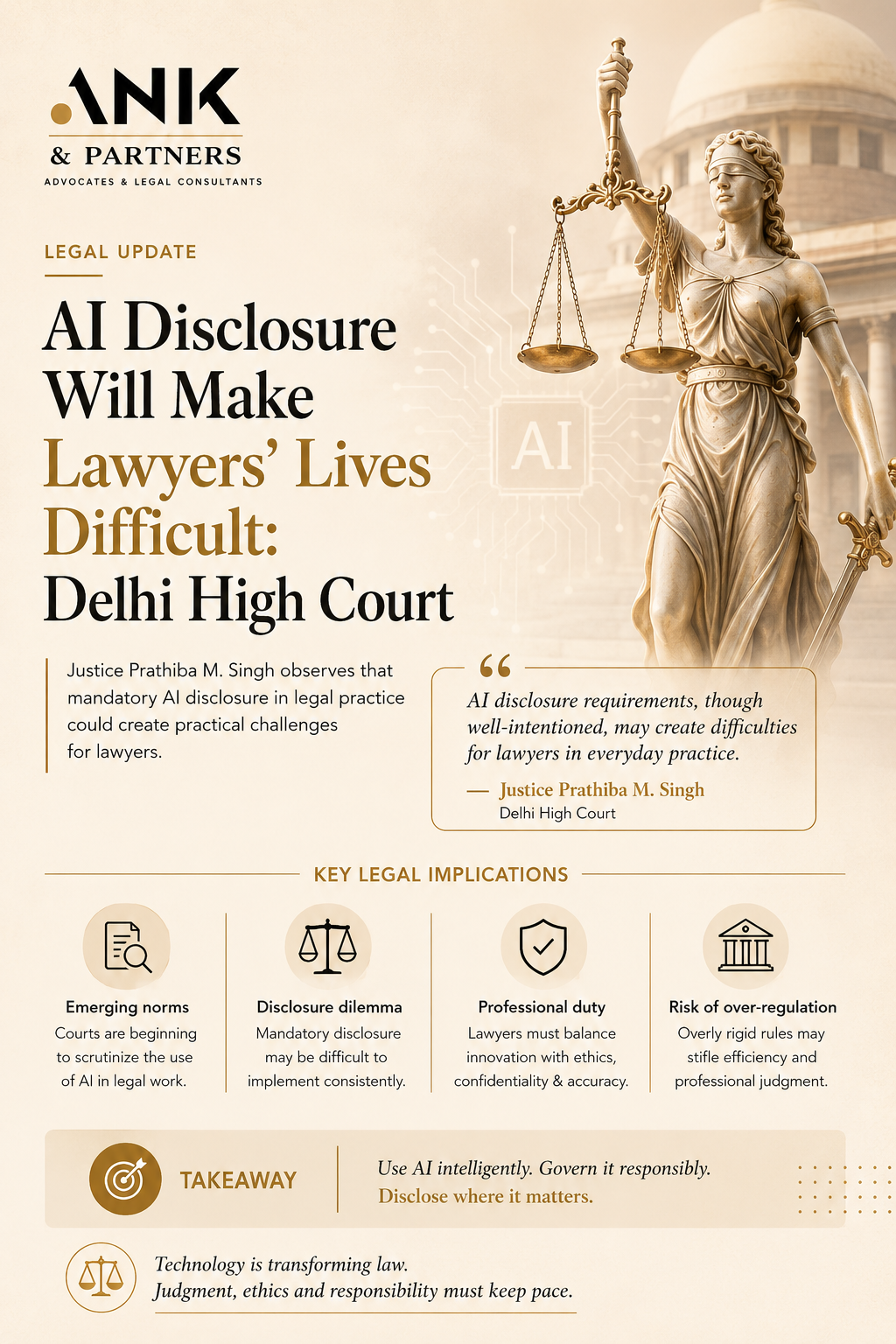
Delhi High Court Justice Prathiba M. Singh has questioned the need to immediately require lawyers to disclose their use of artificial intelligence, observing that such requirements could make lawyers’ lives more difficult and potentially result in another layer of templated affidavits.
The observation comes at a time when courts, lawyers and businesses are increasingly grappling with the responsible use of AI in legal work.
Key Legal Implications
1. AI disclosure may create additional compliance obligations
Mandatory disclosure requirements could add procedural burdens for lawyers, particularly where AI tools are used for research, drafting, summarisation or other routine tasks.
2. Transparency must be balanced with practicality
AI governance should promote accountability without creating formalities that add little substantive value. The challenge will be designing disclosure standards that are meaningful, proportionate and workable.
3. Professional responsibility remains central
The use of AI does not remove a lawyer’s responsibility for the accuracy, confidentiality and quality of legal work. Human judgment and professional oversight remain critical.
4. Courts may shape emerging AI standards
Judicial observations such as these highlight the evolving role of courts in determining how AI should be used responsibly within the legal system.
Business & Compliance Relevance
For businesses, in-house legal teams and professional services firms, the issue extends beyond litigation.
Organisations adopting AI should consider clear internal policies covering:
- Approved AI tools and permitted use cases
- Confidentiality and protection of client information
- Human review and verification of AI-generated output
- Documentation of material AI use
- Accountability for errors or inaccurate outputs
- Evolving disclosure and regulatory expectations
The objective should not simply be “disclose everything.” It should be to create an AI governance framework that is transparent, proportionate and genuinely useful.
The Bigger Picture
AI is transforming legal practice, but regulation must evolve alongside technology.
The emerging debate is therefore not simply about whether lawyers should disclose AI use. It is about how the legal profession can encourage innovation while preserving professional judgment, confidentiality, accuracy and accountability.
Takeaway:
Use AI intelligently. Govern it responsibly. Disclose where it matters.